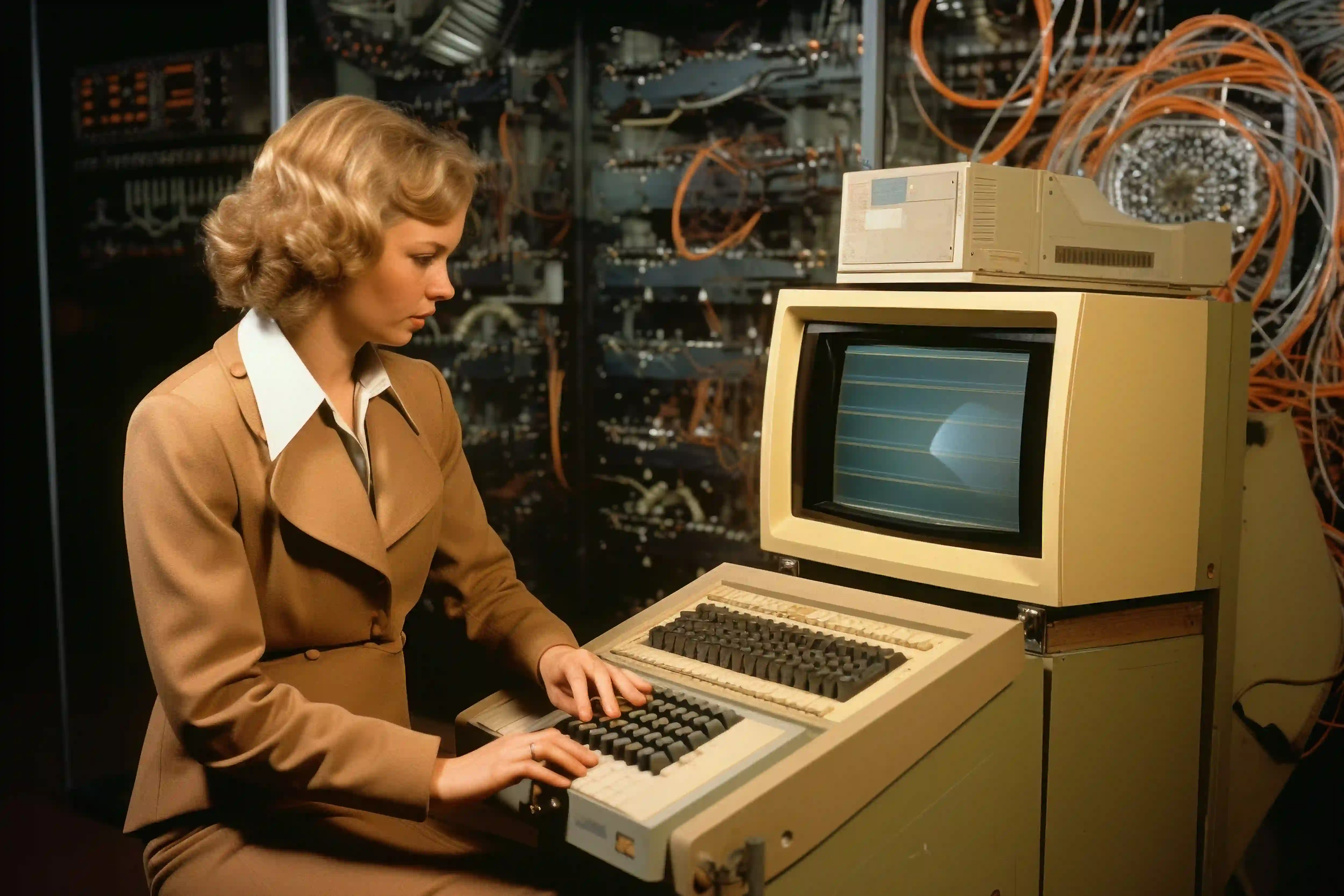
Do you have an outdated system? 5 signs that indicate it.
An outdated system (or software) is one that has been developed according to outdated standards o...
 Beata Miętka
Quality Assurance
Beata Miętka
Quality Assurance
.webp)
In this article, we will try to explain how a CRM system works, why it is useful for managing a company’s customer relationships, and how it helps generate new leads.
Let’s meet Mr John, the owner of a wholesale business supplying parts for agricultural machinery. Spring is approaching, the season is about to start in full swing, and the warehouse shelves are almost empty.
It’s time to make some strategic decisions.
Mr John does not have a sales department, and because maintaining good relationships with existing customers is important to him, he personally takes care of updating stock levels. This is a very common situation in medium-sized companies.
Mr John tries to place an urgent order, so he calls the manufacturer.
Ms Martha answers the phone.
Or rather - she doesn’t, because she’s currently speaking with another customer.
Mr John has to interrupt his own work several times to call again about the order.
He finally gets through on the third attempt.
The order is placed, but the conversation drifts into side topics - the weather, winter, and neighbours.
Time is slipping away.
Ms Martha registers the order in the internal system. However, before she can deal with it properly, she needs to finish previous tasks. When she finally comes back to it, she calls Mr John to inform him about the order status.
More time passes, and the customer’s frustration grows.
Unfortunately, situations like the one described above are still an everyday reality in many companies. CRM systems are particularly useful when, on a daily basis, we need to manage relationships with many customers and repeat many of the same activities.
That’s when it’s worth considering task automation.
We’re not talking about advanced features, but rather a simple CRM system that:
helps generate new leads,
enables sales automation,
speeds up existing sales processes,
supports customer segmentation.
Could this situation have unfolded differently?
CRM stands for Customer Relationship Management - a system used to manage relationships with customers. It allows companies to store contact details, order history, order statuses, and automate communication.
Mr John can log in to his account at any time, from any location - including via a mobile application.
He places an order in just a few clicks, selecting exactly what he needs.
He automatically receives confirmation and status updates, and all email communication is linked to his account.
Ms Martha can see everything in the system - she doesn’t need to call, ask questions, or search for notes.
If needed, the CRM automatically sends messages or email notifications to both parties.
A simple CRM system offers many benefits for both the company and its customers. From the customer’s perspective - someone like Mr John - the biggest advantage is the ability to place orders online without calling or waiting to be connected.
The customer doesn’t get irritated, doesn’t waste time on emails or phone calls. He places the order and doesn’t have to think about it anymore - task completed.
What should you consider when choosing a CRM system? Let’s start with the fact that there are several free CRM tools available on the market. We wrote about them in this article: Free CRM systems.
In such CRM systems, there is no advanced automation, and they cannot be tailored to specific needs. However, if your company is on the smaller side, this may be a suitable solution.
.webp)
simplifies sales,
speeds up customer service through automation,
organises data,
increases customer satisfaction,
saves time for both customers and company employees.
If your company has more specific needs in sales and you care about better understanding your customers, our Simple CRM System is for you.
We created a CRM system that is easy to use - hence the name. 😉 However, its simplicity ends there. Our goal was to support medium-sized companies as well as larger enterprises that currently use or have previously used various CRM tools that did not meet key sales requirements.
Our system supports:
optimisation of sales processes and sales forecasting,
lead management,
integration with other systems,
measurement of advertising campaign performance,
customer data protection.
This list could be even longer. Even the best CRM on the market, if not properly integrated with the company (as is often the case with off-the-shelf solutions), will not fully support business operations.
That’s why Simple CRM is the answer for more demanding companies that are tired of chaos and want sales to be simply easier.
Based on discussions, we are able to introduce changes to our CRM system that meet even the most demanding requirements.
The system operates 24/7, which means purchases can be made at any time - even outside business hours. Thanks to a clear interface, customers have constant access to information about their order, can see its current status, and track progress without contacting customer service.
For a company such as a manufacturer of agricultural machinery parts, CRM primarily means saving time and resources. Employees no longer need to spend hours on phone calls or manual data entry, as most processes are automated and customers place orders themselves through the system.
The CRM platform integrates contact management, process automation, analytics, and reporting, enabling efficient marketing and sales automation and improving customer service quality.
A well-configured CRM system allows a company to serve many customers simultaneously, without time or staffing limitations, significantly increasing its scale of operations. Thanks to a central database, the risk of errors - for example, when rewriting orders from paper notes - is minimised.
Managing the company’s offer becomes easier. A CRM-class system supports not only sales processes but also contract management and service support.
Administrators can easily add products, modify customer data, and monitor orders in real time, providing full control over sales and customer service.
Our Simple CRM System is designed to be implemented almost immediately, without months of analysis, complex development, or costly rollouts. All you need to do is import the product database, add customers, and you can start working right away.
The system was designed so that even users without advanced technical knowledge can easily find their way around. The solution is flexible and can be tailored to the company's specific needs. The system can be integrated with existing warehouse software, invoicing systems, ERP systems, or other internal tools.
See a related article: ERP and CRM systems – differences and similarities
Thanks to this, the company saves time by reducing repetitive tasks and gains greater operational efficiency. Customers are served faster, more accurately, and without unnecessary delays, resulting in higher satisfaction. As a result, CRM becomes not only a convenient operational tool but also a lever for business growth.
It is also worth emphasising that CRM is the place where all key information comes together - about customers, orders, and the offer. CRM solutions enable contact management, customer segmentation, and analysis of customer behaviour.
Instead of working across multiple tools, a company can manage everything from a single system, significantly simplifying daily operations.
Finally, CRM provides continuity. If one person starts handling a customer and another needs to take over, everything is recorded in the system. There is no need for sticky notes, searching through emails, or asking colleagues about previous arrangements.
This way of working increases professionalism and builds customer trust.
The story of Mr John and Ms Martha shows that many everyday customer service challenges stem not from a lack of willingness, but from a lack of proper tools. A simple CRM system changes this picture.
It automates repetitive tasks such as sending emails or notifications, organises information, and allows both sides to work more efficiently.
Ms Martha does not need to answer dozens of phone calls a day or search for information in different places - everything is at her fingertips. Mr John can place an order independently and conveniently without waiting to be connected.
As a result, work becomes more organised, faster, and less stressful - for both employees and customers. And it is precisely these small changes that have the greatest impact on company growth and a positive brand image.
Today, customer data security is the foundation of trust and professionalism for every company. That is why our Simple CRM System was designed in line with the highest data protection standards.
Thanks to advanced encryption, access control, and regular backups, you can be sure that all customer data is safe and protected from unauthorised access.
The CRM system also meets all GDPR requirements, meaning that customer relationship management is fully compliant with applicable regulations. This is not only protection against potential penalties, but above all, a guarantee that your customers can feel safe entrusting you with their data.
Modern business requires efficient information flow between different tools and platforms. Our CRM system was created with easy integration in mind - with ERP systems, e-commerce platforms, and social media tools.
Thanks to this, all key data - from orders and contacts to communication history - is available in one place, making customer relationship management significantly easier.
Integrating CRM with e-commerce systems enables sales automation, better sales forecasting, and more effective marketing campaigns. Integration with social media allows companies to monitor customer behaviour and respond quickly to their needs.
An interesting solution is adding AI-based applications, which can further support marketing teams in creating the most effective campaigns.
Information provided by marketing serves as a foundation for sales teams to improve customer service standards and, at a later stage, introduce sales automation.
Such a comprehensive solution makes your company operate more smoothly, and customer service becomes even more effective.
Implementing a new CRM system is an important step in a company’s development, which is why we offer full support at every stage of the process.
Our team of experts provides practical training that allows employees to quickly master the CRM system and use its capabilities in their daily work.
In addition, we provide ongoing technical support - we are available to answer questions, resolve any issues, and help you fully utilise the CRM system’s potential.
This ensures that implementation runs smoothly and your company quickly begins to benefit from modern customer relationship management solutions.
Find out what you can do to support your business
More like this