
Does my company need a dedicated system?
When a company faces certain problems or challenges, its owner(s) ask themselves what could solve...

.webp) Kamil Zawadzki
Managing Partner
Kamil Zawadzki
Managing Partner
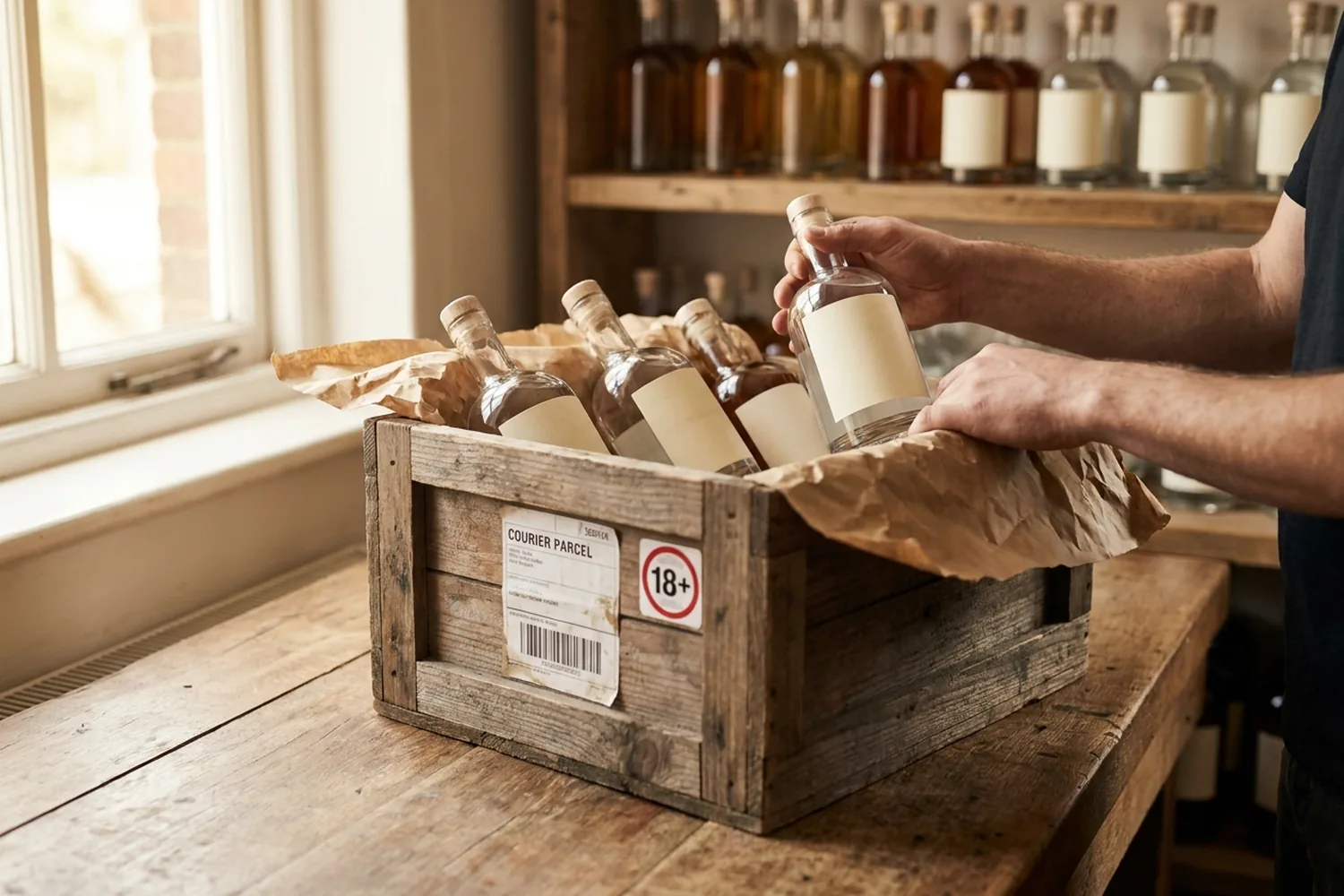
Yes — selling alcohol online in the UK is legal. In England and Wales you need two licences: a premises licence for the place you dispatch from, and a personal licence for the person responsible for the sales.
On top of that comes excise duty — from 1 February 2026 for example £26.61 per litre of pure alcohol for wine and spirits at 3.5–8.4% ABV — import clearance, and a courier who checks ID on delivery. The guide walks through all of it, using Polish spirits as the example. The general rules of a UK-facing store — VAT, customs, payments — are covered in the online store in the UK guide.
It is — in England and Wales it is governed by the Licensing Act 2003, and what gets licensed is the place the alcohol physically leaves: a warehouse, a shop, even a home. An online store with no shopfront still needs the licence, because the licence follows the storage-and-dispatch site, not the website.
Scotland runs its own licensing system and Northern Ireland has its own rules — the differences get their own section below. This guide describes the base case: selling from a warehouse in England or Wales.
Two things at once. A premises licence authorising off-sales covers a specific address — the warehouse you pick and dispatch from. The licence names a designated premises supervisor (DPS): the person responsible for alcohol sales from that site, who must themselves hold a personal licence.
A personal licence requires being 18 or over and holding an accredited licensing qualification (such as the Level 2 Award for Personal Licence Holders). Applications go to the local licensing authority.
The practical shortcut: before you sign for a warehouse, confirm with the local licensing authority that a premises licence authorising off-sales can cover storage and dispatch from that address.
Excise duty is charged per litre of pure alcohol, by strength. The rates in force from 1 February 2026: beer at 3.5–8.4% — £22.58, wine and spirits at 3.5–8.4% — £26.61, all categories at 8.5–22% — £30.62, above 22% — £33.99 per litre of pure alcohol. Concretely: a 0.7-litre bottle of vodka at 40% is 0.28 litres of pure alcohol, so 0.28 × £33.99 ≈ £9.52 of duty.
Alcoholic products become liable for UK excise duty on arrival — declared by the importer or their customs agent. And the sentence that matters most for e-commerce: the "VAT at checkout up to £135" simplification **does not cover excise goods**. Every parcel containing alcohol is a full import with duty and clearance, regardless of value — which is why the standard model is stocking a UK warehouse with one bulk clearance and selling from there.
One piece of good news: duty stamps on high-strength alcohol were abolished on 1 May 2025 — that obligation is off the list.
Alcohol Wholesaler Registration Scheme registration is needed when you sell alcohol to other businesses for resale — including when you import it and sell wholesale to restaurants or shops. Selling only to consumers does not require AWRS.
For the Polish-spirits model this is an important fork: a B2C store for individual customers — no AWRS; supplying Polish restaurants and shops in the UK — AWRS before the first invoice. The other side of the coin: if you buy stock from a UK wholesaler, they must be AWRS-registered — buying from an unregistered wholesaler is an offence for the buyer too.
The line is simple — selling alcohol to anyone under 18 is illegal, and a licensed seller must operate an age-verification policy. The market standard is **Challenge 25**: anyone who looks under 25 shows ID.
With online sales the verification moves to the customer's doorstep — and here is the key sentence: the seller remains responsible for the delivery complying with the law, even when a courier carries it. That is why sellers use age-verified courier services (marketed as "No ID, No Delivery": no document, no handover), and describe the liability for handing alcohol to a minor explicitly in the carrier contract before the first parcel ships.
A practical store setup: an age gate at the entrance, 18+ product labelling, a date-of-birth field in the checkout, and an "age verification required" flag passed into the courier's system — matched to your age-verification policy.
The starting point is the seller — whoever formally makes the retail sale (the seller of record) and answers for its legality. The premises licence covers the storage-and-dispatch site, excise duty on import is declared by the importer or their agent, and the seller accounts for the VAT. Earning commission on someone else's sales is a different role from selling in your own name.
The variants look like this:
You sell in your own name (you buy the stock and list it as yours): in practice you arrange the licences, the import and the settlements — and the margin is yours.
You intermediate for a commission: the owner of the goods remains the seller, and the licences usually sit on their side; your role is the platform and the marketing.
A marketplace: the platform can be the deemed supplier for VAT, but the £135 simplification does not cover excise goods, and tax rules do not transfer alcohol licences.
The label of the model alone settles nothing, though: who needs the licences and who answers for import, duty and VAT follows from the roles, the dispatch site and the payment flow. Set that structure with a solicitor who works in alcohol licensing before sales start. This guide gives orientation — it does not replace legal advice.
Quite a lot. Scotland has its own licensing system (the Licensing (Scotland) Act 2005) and **minimum unit pricing**: since 30 September 2024 alcohol cannot be sold below 65 pence per unit. MUP does not cover orders dispatched into Scotland from outside it, but a warehouse in Scotland means the full Scottish rulebook. Wales has its own MUP at 50 pence. England and Northern Ireland have no MUP, with Northern Ireland running a separate licensing order altogether.
The operational conclusion: your warehouse address chooses your legal system. The simplest variant is a warehouse in England shipping UK-wide — and confirm the UK-wide dispatch model with a solicitor either way.
The platform closes the technical part of the puzzle: the age gate, 18+ labelling, date of birth in the checkout, the age-verification flag in the courier integration, product data with strength and volume (the basis for duty calculations), prices in pounds and the payment methods UK customers expect.
On your side, with your lawyer, remain: the licences (premises + personal), the tax registrations, the carrier contract and the seller-of-record decision from the previous section. That is how we split it in practice: we deliver the store, a specialist runs the licences.
Milio — the e-commerce platform from Webchefs, built as dedicated code — is priced from 10 965 zł net + 1 500 zł/month in the care model (the subscription includes 4 hours of development work a month) or from 28 965 zł net one-off with code ownership (further support billed at 260 zł/h). We show a working demo with your catalogue and the age-verification flow before you sign anything.
We will show a demo with your catalogue and the age-verification flow before you sign anything. Licences go to your lawyer — we deliver the store.
More like this